
Children's Furniture Assembly on Manhattan's Upper East Side: What Makes a Room Ready?
A nursery or kids' bedroom isn't finished when the final panel goes in. Here is what matters when assembling cribs, beds, dressers, shelves, and storage—and why wall anchoring belongs in the plan from the beginning.

The short answer: assembly, placement, and anchoring are one plan
Children's furniture assembly means more than connecting the right pieces. The furniture must be assembled according to its instructions, positioned where it can function, and secured against tip-over where appropriate. In a child's room, every freestanding storage piece with drawers, doors, or shelves—such as a dresser, wardrobe, bookcase, or toy-storage cabinet—should be properly anchored to the wall. A unit that looks level is not necessarily protected against tipping.
That last point is not merely a design preference. The U.S. Consumer Product Safety Commission's Anchor It! campaign calls for anchoring furniture with drawers, doors, and shelves to help prevent tip-over injuries.
Cribs and beds are different: use their own manufacturer's installation requirements. Do not drill a crib or bed frame into a wall unless the product is designed and instructed to be installed that way.
Start with the room, not the first box
A child's bedroom is a working space before it becomes a finished space. That is easy to forget in a Manhattan apartment where floor area, access, and storage can be limited.
In the work-in-progress photograph from one of our children's furniture assemblies, you can see bed components, organized hardware, and protective floor mats before the furniture reaches its final position. This is the part of the work that rarely makes the finished-room photograph, but it matters.
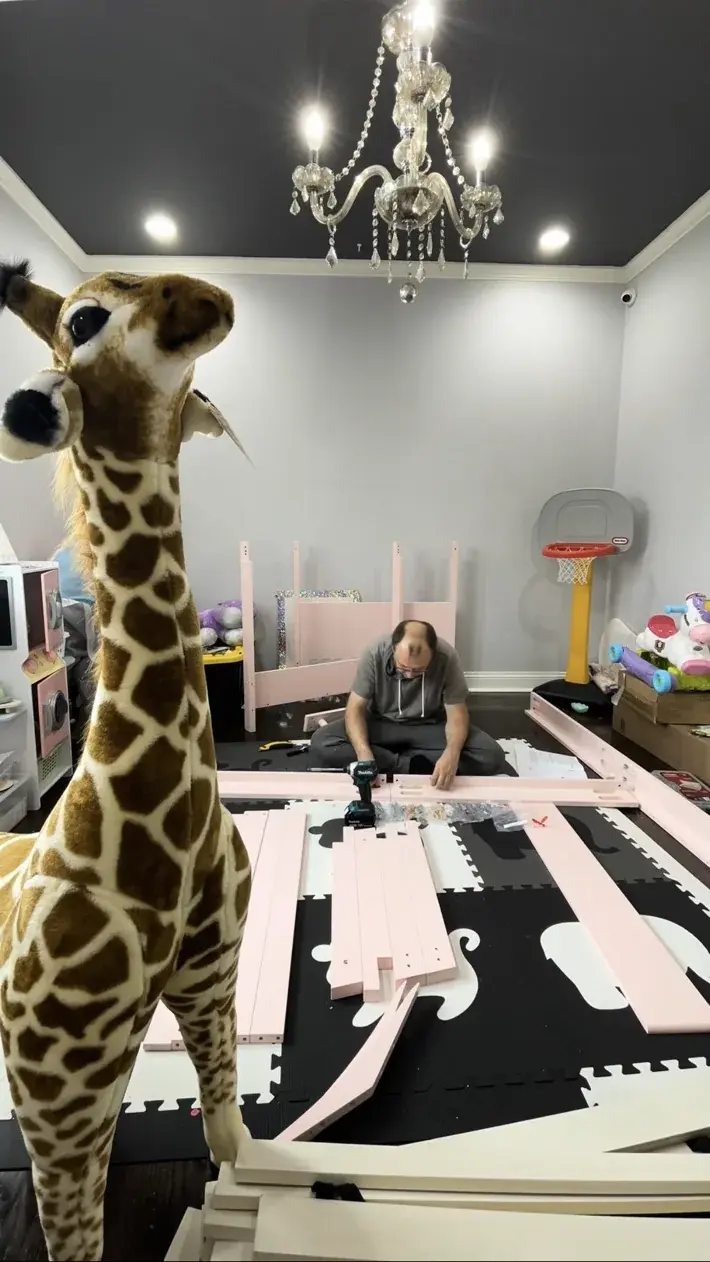
Before final assembly, it helps to establish three things: where the assembled piece will sit, whether drawers and doors will open fully, and which storage items need wall anchoring. A perfectly assembled dresser still needs access to an appropriate anchor point. Finding that out only after it has been loaded and pushed into place makes the last step unnecessarily difficult.
For families preparing a nursery or playroom, it also helps to have manufacturer instructions, product links, and all delivered hardware available at the start. Missing or damaged parts should be identified—not improvised around.
Wall anchoring: the step that can't be skipped
Yes, children's dressers, wardrobes, bookshelves, cabinets, and freestanding toy-storage units with drawers, doors, or shelves should be secured to the wall. Their apparent stability when standing still does not replace an anti-tip restraint. This applies to new furniture and existing furniture, including pieces that are relatively short or have a sturdy-looking base.
The anchoring method depends on the product, its restraint kit, and the actual wall construction. Manhattan interiors can have drywall, plaster, or masonry, and those surfaces do not all accept the same fasteners. The correct approach is to follow the furniture and anchor manufacturer's instructions, identify the supporting structure, and select the appropriate hardware for that structure. CPSC's anchoring guidance explains why the wall type matters.
If a co-op, condo, or rental building has rules for wall drilling, resolve access and approvals before installation. A building rule does not eliminate the need to address tip-over risk; it means the anchoring plan needs to be agreed before the room is put into use.
Important distinction: a wall-attached shelf or cabinet also needs its specified load-bearing mounting system. A light-duty anti-tip strap is not a substitute for structural mounting. Conversely, a crib, toddler bed, or bunk bed should not receive improvised wall attachments simply because it is children's furniture; follow the instructions for that particular product.
Cribs, toddler beds, and bunk beds: different checks
Cribs and convertible beds
Cribs are product-specific assemblies. The correct screws, brackets, mattress support, and configuration matter. Never substitute random hardware for missing crib parts or modify a crib to make a panel fit. The CPSC crib-safety checklist specifically warns about missing, loose, broken, and incorrectly installed hardware. Mattress fit and the manufacturer's conversion instructions matter, too.
Bunk beds and loft beds
Elevated sleeping furniture adds guardrails, ladders, connection points, and mattress-thickness limits to the checklist. A mattress that is too thick can reduce the effective height of a guardrail. CPSC's bunk-bed guidance explains the relevant guardrail and mattress requirements. Follow the warnings and the instructions for the actual bed, including age restrictions for the upper bunk.
Dressers, changing tables, and playroom storage
Check the intended configuration, then position and secure the unit appropriately. A changing table's original accessories and manufacturer directions matter; so do the anchoring requirements of any accompanying dresser or storage cabinet. Drawers and doors should open without catching on adjacent furniture. All relevant anti-tip restraints should be installed before children use the room.
From a single crib to a complete children's room
A Guy Who Can Fix It provides children's furniture assembly and installation throughout Manhattan, including the Upper East Side. Projects can include cribs, toddler and bunk beds, dressers, changing tables, wardrobes, bookshelves, toy storage, children's desks, chairs, and complete nursery or playroom sets.
We work with furniture from brands such as IKEA, Pottery Barn Kids, Crate & Kids, RH Baby & Child, Babyletto, Nestig, Stokke, and Delta Children. These are product brands, not manufacturer partnerships or certifications.
The practical difference between assembly and a finished room is simple: panels can be connected while drawers are still misaligned, a wardrobe isn't level, or a bookshelf hasn't been anchored. The final check should cover the actual installation requirements, not only the last fastener in the box.
For everyday furniture assembly, our published rate is $149 per hour for one Guy, with a one-hour minimum. Larger room installations can be scoped as a project estimate. Hardware or components that must be purchased separately are not included in the hourly rate.
Questions parents ask
Does every piece of children's furniture need to be attached to a wall?
Anchor freestanding storage furniture with drawers, doors, or shelves, including dressers, wardrobes, bookcases, and storage cabinets. Cribs and beds are not automatically wall-mounted: follow each model's own installation instructions. If a furniture piece is intended to be wall-mounted, it needs the mounting system specified for its weight and use.
Can a dresser be safe if it does not wobble?
Not by that test alone. A stable-looking dresser can still present a tip-over hazard if a child pulls on drawers or climbs. Proper anti-tip anchoring is the relevant safeguard, not the absence of wobble.
What if my apartment has plaster or masonry walls?
The wall material changes the required anchoring hardware and method. Confirm the substrate and any building rules before attaching furniture. Avoid generic substitutions without verifying their suitability for the actual wall and product.
What should I send before a children's furniture assembly appointment?
Send the product links or model names, quantities, any assembly instructions you have, a description of which pieces need anchoring, and the building's access or wall-drilling requirements. For several items or a complete room, a simple layout or room photograph helps plan the job.
Sources and related reading
- U.S. Consumer Product Safety Commission — Anchor It!: why storage furniture and similar items should be anchored.
- CPSC — How to install an anchoring kit: choosing the method for the wall.
- CPSC — Crib safety tips: hardware and mattress-related safety considerations.
- CPSC — Bunk beds business guidance: guardrails and mattress limits.
- Our Furniture Assembly & Installation service: service scope, pricing, and installation details.
- More on furniture assembly in Manhattan: a broader look at assembly versus installation.
Ready to assemble your child's room?
From a single crib to a complete nursery or playroom, our Guys can handle the assembly and the agreed installation work, including the anchoring your storage furniture needs.