
Home Maintenance
Dryer Maintenance in Manhattan: What a Clean Lint Filter Misses
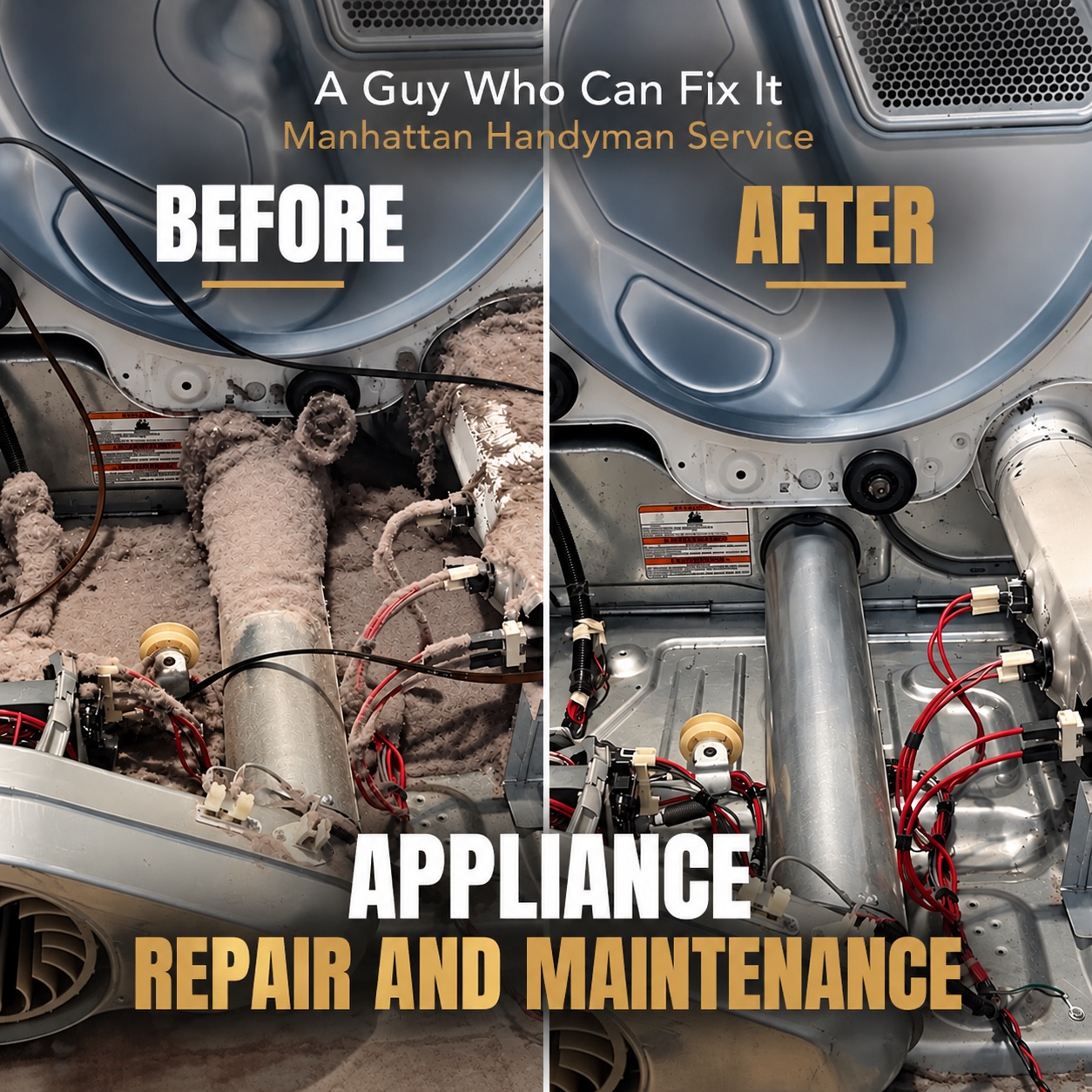
A dryer can look clean where you load the laundry and still hold lint, worn parts, or a trapped sock inside its cabinet. Two Manhattan service calls show why maintenance needs to go beyond the filter—and why a dryer that stops heating does not automatically need a new heating element.
What does dryer maintenance actually cover?
Dryer maintenance combines internal cleaning, inspection of the drum supports and seals, checks of the heating and temperature-protection components, and a test after reassembly. Vented dryers also need attention to the exhaust path; heat-pump dryers need attention to the heat exchanger and condensate system.
Cleaning the lint screen remains essential. It does not provide access to the inside of the cabinet or tell you whether a drum seal, roller, or exhaust connection needs attention.
Lower East Side: a four-year-old Whirlpool that stopped heating
The customer's complaint was straightforward: the dryer ran, but the clothes stayed cold. It had worked before and now produced no heat.
This was an electric Whirlpool, about four years old, in a household with four children. The washer and dryer handled frequent loads. Once we opened the dryer and removed the drum, we found a child's sock inside the cabinet near the heating assembly, along with accumulated lint.
The drum seal was worn. Our inspection identified the damaged seal as the route the sock had taken out of the drum. Testing found a failed thermostat following overheating; the heating element itself was still working.
We cleaned the interior and replaced the failed thermostat and worn drum seal. Heating returned, and the dryer operated normally during the test afterward. The customer subsequently left a positive Google review.
The useful finding: replacing the heating element would not have addressed this failure. Replacing only the thermostat would also have left the damaged seal in place. The repair needed to restore heat and correct the opening that had allowed clothing into the cabinet.
Chelsea: the problem started behind the dryer
Another customer lost heat after a cleaning company had moved the dryer to clean behind it. When the machine was pushed back, its flexible exhaust connector was crushed.
The drum continued turning, so the problem was not immediately obvious to the owner. Our inspection found the restricted connector and a failed temperature-protection component after overheating. We corrected the crushed connection and replaced the failed component; normal operation returned.
The lesson applies whenever an appliance is moved: the space behind it matters. A connector that looks fine while the dryer is pulled forward can become compressed when the machine is pushed back into position.
Whirlpool's venting guidance explains that restricted exhaust can affect drying and recommends suitable metal venting. A damaged or unsuitable connector needs the correct replacement for the installation—not simply another squeeze behind the machine.
Why “runs but won't heat” needs a diagnosis
Our first inspection on an electric dryer with no heat includes the heating assembly. A visibly broken heating coil is useful evidence, but we still test the components rather than ordering a heater from the symptom alone.
With the appliance safely isolated, we check the heating element, relevant thermostats and thermal protection, and other components indicated by the fault. Readings are compared with the service information for the model. We also inspect the airflow path and look for lint, foreign objects, damaged seals, and evidence of overheating.
A thermostat, thermal fuse, and temperature sensor are not interchangeable names for the same part. Their functions, ratings, and replacement procedures depend on the dryer. A failed protective component also raises a second question: what caused it to fail?
A concrete parts example from LG
LG's commercial laundry parts documentation lists the 5301EL1001J heater assembly, 6931EL3003D thermostat, and 6931EL3001F thermostat assembly together in specified electric dryer configurations. These are examples of separate components in a heating system that a technician may need to check. They are not the parts identified on our Whirlpool job.
The model's parts list determines the correct combination. A similar-looking housing, or a familiar part number in an online listing, is not enough to establish compatibility. See the LG parts book, printed page 61.
What we do during a maintenance visit
With clear access, our maintenance visits generally take about an hour. Removing a stacked appliance or working in a tight closet can take longer.
The following describes professional service, not a disassembly guide. Access methods vary by model, and gas appliances require appropriate isolation and handling of their connections.
- Make the appliance safe and open it for access. On the vented designs we commonly service, removing the necessary panels and drum exposes areas that cannot be reached through the lint-filter opening.
- Remove accumulated lint and debris. We clean the accessible cabinet interior, drum, motor area, heating area, and internal air passages. On vented machines, we also clean the accessible exhaust section within the service scope below.
- Inspect the mechanical parts. We check drum seals, rollers, supports, the drive belt, and related tensioning parts. When a roller is worn, we replace the roller assembly rather than only its bearing: its outer running surface also wears.
- Check the relevant electrical and safety components. We test thermostats, temperature-related components, and other accessible parts as appropriate to the model and findings. Cleaning does not substitute for diagnosis.
- Reassemble and test. We check drum movement, heating, and abnormal noise during a test cycle. Our checks include infrared surface-temperature readings around accessible drum and exhaust areas. These readings support the inspection; they are not a direct measurement of air temperature or a substitute for model-specific tests.
Rollers, lubrication, and preventive belt replacement
Our team uses Super Lube Multi-Purpose Synthetic Grease with Syncolon (PTFE) in its maintenance work on serviceable bearings and supports. The product is a multipurpose synthetic grease; the lubrication points and whether lubrication is appropriate must still be determined for the particular assembly. We do not recommend applying it indiscriminately to every roller, belt, or drum surface. Product information.
For belt-driven dryers, preventive belt replacement is part of our maintenance approach. We prefer to replace the belt while the machine is already open rather than wait for a break and another service visit. This is our service policy, not a claim that every manufacturer requires a new belt every six months.
How far does the vent cleaning reach?
Our service covers approximately 10–16 feet of accessible exhaust duct from the dryer, depending on the route and access. That is about 3–5 meters. It does not mean that an entire building exhaust system has been cleaned.
We use a lighted inspection camera that sends a live image to a phone to examine reachable sections. In our experience, lint often builds up along the duct rather than at one isolated point. A camera helps document what can be seen; bends, access, and obstructions determine how far it can travel.
If the concern extends into a shared building exhaust system, we explain the finding and recommend that the customer involve the superintendent or building management. Roof outlets and inaccessible sections require separately arranged access and service. A clean section near the dryer is not proof that the full route to the outside is clear.
Heat-pump dryers need maintenance too
Heat-pump dryers do not use an outdoor exhaust duct. Their maintenance therefore focuses on a different moisture and airflow path.
On the machines we service, a recurring finding is damp lint accumulating on the heat exchanger. Our work includes cleaning the accessible heat-exchanger surfaces, condensate collection area, drainage path, and pump, with access and cleaning methods adapted to the model. This is maintenance of the accessible components, not opening the sealed refrigerant circuit.
We also service conventional condenser dryers and gas dryers. A conventional condenser dryer is not necessarily a heat-pump dryer. Gas and electric vented dryers share some cleaning tasks, but their heating systems and diagnostic procedures differ.
Five examples of heat-pump dryers in the U.S. market
These model references illustrate the category; they are not a sales ranking or a claim that we performed the cases above on these machines.
| Model | Format | Reference |
|---|---|---|
| LG DLHC5502W | Full-size ventless heat-pump dryer | LG |
| LG DLHC1455W | Compact ventless heat-pump dryer | LG |
| Bosch 500 Series WQB245B0UC | Compact heat-pump dryer | Bosch |
| Bosch 800 Series WQB245AXUC | Compact heat-pump dryer | Bosch |
| Miele T1 TXI680WP | Compact ventless heat-pump dryer | ENERGY STAR model record |
What is included in the $299 service?
Our $299 dryer maintenance service covers internal cleaning, inspection, testing, and the small replacement items described below. The same base price applies to heat-pump models, with the cleaning scope adapted to their design.
| Included in standard maintenance | Quoted separately when needed |
|---|---|
| Internal cleaning and component inspection | Replacement drum seals |
| Preventive drive-belt replacement on belt-driven models | Heating-element or motor replacement |
| Replacement rollers and fuses when required | Other major repairs or components outside the included items |
| Accessible vent cleaning, approximately 10–16 feet, on vented dryers | Shared building ducts, roof access, or inaccessible exhaust sections |
| Applicable heat-exchanger and condensate-system cleaning on heat-pump models | Additional handling for stacked units or restricted access |
| Reassembly and operational testing | Work requiring a second technician to move the appliance safely |
If the dryer must be removed from a stack or pulled out of a difficult enclosure, we agree on the access-related price before the visit. A failed heating element or motor moves the job beyond routine maintenance and requires a separate repair estimate.
The Lower East Side story is a repair example, not a promise that every similar repair costs $299. Its replacement drum seal was outside the standard maintenance package.
How often should you schedule maintenance?
For households using the dryer daily or every other day—particularly large families or homes with pets—we recommend considering professional maintenance about every six months. That recommendation comes from our service experience with intensive use.
For lighter use, the interval should reflect the model's instructions, actual lint buildup, and the installation. We have customers who arrange internal service less frequently, but that does not remove the need to clean filters and maintain the vent on its own schedule. Whirlpool's care guidance recommends yearly vent cleaning or cleaning when performance indicates a need.
Many of our no-heat calls feel sudden to the owner: the machine dried yesterday and does not today. Waiting for an obvious warning is therefore not a reliable maintenance plan. Longer drying times, unusual heat, new noise, or a burning smell should still be taken seriously when they occur.
Four habits that help between visits
- Clean the lint screen after each load. For a heat-pump model, also follow its instructions for the additional filters and their cleaning schedule.
- Respect the dryer’s load limit. Use the capacity and cycle guidance in its own manual. A drum packed tightly with laundry is not the same as a suitable drying load.
- Spin laundry before drying it. Load damp, spun laundry—not items dripping water straight from a basin. If the washer did not spin properly, resolve that first.
- Empty pockets. Coins and other small objects are a recurring source of noise and trapped debris in the machines we inspect.
If you notice a burning smell, smoke, or repeated electrical tripping, stop using the dryer and have the cause assessed. Do not keep restarting it to finish the load. Internal electrical tests, gas work, and moving stacked appliances belong with a qualified technician.
Questions customers ask
Can a dryer run normally but produce no heat?
Yes. The drum can turn while the heating system is not operating. In our Lower East Side case, the thermostat had failed and the heating element was still functional. The symptom alone does not identify the failed part.
Is cleaning the lint filter enough?
No. It is routine owner care, but it does not clean the cabinet interior, inspect drum seals or supports, or establish that a vented dryer's full exhaust route is clear.
Does a ventless dryer need duct cleaning?
It has no outdoor dryer exhaust duct to clean. Its filters, heat-exchange surfaces, and condensate system still require the care specified for its design.
Should I buy a heater before booking a repair?
Wait for a diagnosis. Confirm the appliance's full model number and the failed component before ordering parts. A familiar-looking heater or thermostat may not be correct for your dryer.
Sources and service information
The Lower East Side and Chelsea accounts, maintenance scope, pricing, and field observations come from our team's work. Manufacturer references explain particular products and care principles; they do not independently document our customer visits.
- Whirlpool: checking dryer venting
- Whirlpool: dryer cleaning and care
- LG: commercial laundry parts reference
- Super Lube: multipurpose synthetic grease
For diagnosis and repair information, see our appliance repair service in Manhattan.
Planning a dryer maintenance visit? Send the model number and a photo showing how the dryer is installed so we can confirm access and scope. Book Your Guy.